
Neurodevelopmental
Speech delay
One of the most common early symptoms in children, addressed at its root.
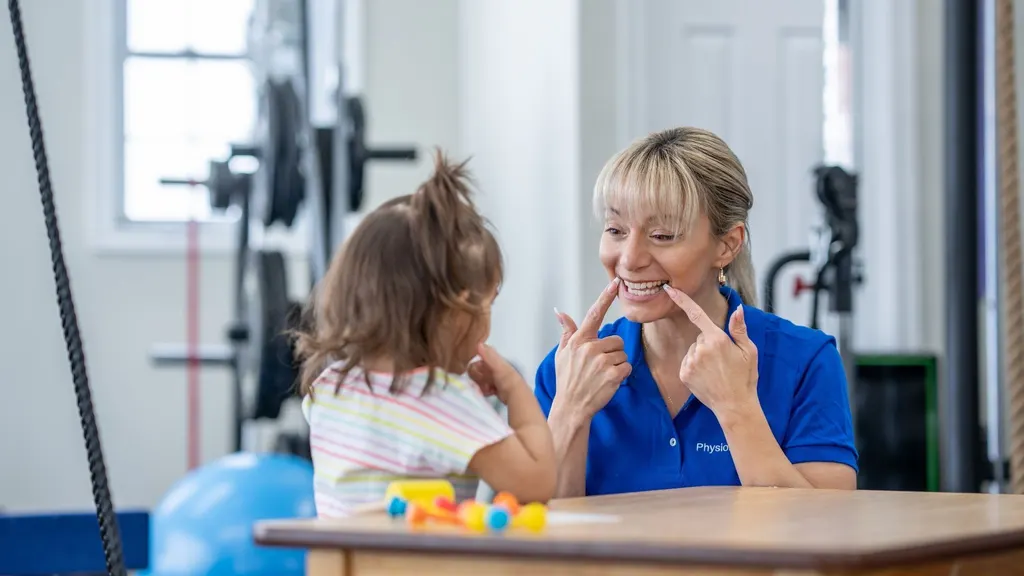
Speech delay is one of the most common reasons parents of toddlers first look for help: a child who is two and still not talking, or three and hard to understand. At the Wellness Institute of Neurodevelopment (WIN) in Houston and San Juan, we start by asking why. Hearing, auditory processing, oral-motor skills, retained reflexes and nutrition can all hold speech back, and finding the cause is what lets us build a plan that helps your child catch up.
What is speech delay?
A speech delay means a child is developing speech and language more slowly than expected for their age. Speech is the mechanics of making sounds and words; language is understanding what is said and using words to communicate. A child can be delayed in one, the other or both, and the distinction matters for treatment.
For a child to talk, the ear has to capture sound clearly, the brain has to organize and attach meaning to it, and the mouth, tongue and breath have to coordinate to produce it. A weak link anywhere in that chain shows up as late or unclear speech.
Speech delay is not the same as autism, and it is not a sign of low intelligence. Many children who talk late understand far more than they can say. It is also not something to simply wait out: the earlier the cause is found, the easier it is to address.
Early signs of speech delay parents notice
These are milestones most pediatric guidelines agree on. If your child is missing the ones for their age, it is worth a closer look:
- By 12 months: does not babble with consonant sounds like "ba" or "da," does not respond to their name, and does not use gestures such as pointing, reaching up or waving.
- By 18 months: says only a handful of words or none at all, does not point to show you something, and does not follow simple one-step directions like "give me the cup."
- By 24 months: is not putting two words together ("more juice," "daddy go"), has a vocabulary that is not growing week to week, or mostly repeats what you say rather than using words on their own.
- By 36 months: does not use short sentences, cannot be understood by people outside the family most of the time, and does not ask simple questions.
- At any age: stops using words they once had, seems not to hear you from another room, or frequently says "what?"
If you see one or more of these, or your gut tells you something is off, request an evaluation. Waiting for a child to grow out of it costs time the brain uses best early.
What causes speech delay, and why that matters for treatment
Speech delay is a symptom, not a diagnosis, and WIN's job is to find what is behind it. Hearing comes first: fluid behind the eardrum from repeated ear infections can muffle sound for months at the very age a child is learning words. Just as often, the ear works fine but the brain struggles to process what it hears. That is central auditory processing disorder (CAPD), and a child with it may hear your voice without being able to pull words out of background noise or hold a sequence of sounds long enough to copy it.
WIN also evaluates oral-motor coordination, retained primitive reflexes that interfere with mouth and tongue control, and the neurological and medical picture: nutritional deficiencies, food sensitivities, gut problems and inflammation that research increasingly links to brain development. And we answer the question most parents are afraid to ask. Speech delay can be an early sign of autism, but most children with a speech delay are not autistic. Our evaluation looks at the whole child so you have an answer, not a worry.
How WIN evaluates speech delay
The process starts with Phase I — Evaluation and planning. The initial medical evaluation is a three-part visit, typically 1–1.5 hours with Dr. Báez-Franceschi and about 3 hours in the office, including medical and neurodevelopmental testing, a review of pregnancy, birth, ear infections, feeding and milestones, and an initial plan.
Specialized laboratories depend on the child. For speech delay they commonly include nutritional deficiencies, a food allergy panel and metabolic panels, with genetic testing or environmental toxins added when the history points there. The physician reviews the results with you at the follow-up appointment and sets a protocol for any medical conditions found.
Three of the WIN neurodevelopment evaluations are central to speech delay. The tympanogram checks whether the middle ear is moving sound properly, which rules fluid in or out. The listening test (CAPD) measures how the brain processes what it hears. The Franceschi Method development test maps language, motor and sensory skills against expected development, and the primitive reflex test adds the oral-motor picture. You leave with a written, individualized treatment protocol.
How we treat speech delay: the three phases
Phase I — Evaluation and planning finds the cause and begins treating it: middle-ear problems, nutritional gaps and other medical conditions are addressed through dietary modification, functional medicine and conventional medicine when needed.
Phase II — Evaluation results and protocols starts the medical and nutritional plan. For a child with speech delay, that typically means a nutrition protocol with dietary modification and individualized supplementation to support neurotransmitter production, along with functional protocols based on the labs. With the neurodevelopment evaluations complete, we discuss a treatment protocol that targets speech directly, plus the reflexes, motor skills, sensory integration and attention that speech depends on.
Phase III — Multisensory and psycho-emotional therapy is where auditory and sensory work complements, rather than replaces, speech therapy. The Franceschi Neuro-Auditory Protocol trains the brain to process sound so that words become easier to distinguish and reproduce. The sensory room helps a child regulate and attend, and gym work builds the motor coordination and body awareness that support oral-motor control. Progress is measured constantly, and parents receive reports and training to carry the work into daily routines. Read more about the Franceschi Method®.
What families can expect
The first month concentrates the evaluation: the initial visit, labs, a follow-up and the WIN neurodevelopment tests. Therapy then runs on a regular schedule at our Houston or San Juan center, with re-evaluations to adjust the plan. Families in Texas, Florida and Puerto Rico can do medical follow-ups by telemedicine, and families from elsewhere travel to Houston or San Juan for blocks of therapy.
When the cause of a speech delay is identified and treated, parents often report that their child responds to their name more, imitates more sounds and attempts more words. Catch-up is common, though the pace depends on the cause and the child's age, and practice at home is part of the protocol.
If your child is behind on talking and you want to know why before you decide what to do, we can help. Request an orientation with WIN in Houston or San Juan, in English or Spanish, and we will explain what an evaluation would involve for your child.
How it works
How WIN approaches speech delay
- I Evaluation and planning Initial medical evaluation · Specialized laboratories · Follow-up appointment
- II Evaluation results and protocols Medical and nutritional protocols · WIN neurodevelopment evaluations · Treatment protocol discussion
- III Multisensory and psycho-emotional therapy Therapy sessions and progress measurement
Therapies and services that help
All servicesFranceschi Neuro-Auditory Protocol
Integrated Listening System (ILS) for auditory processing.
Learn moreSensory room
A controlled space for sensory integration and regulation.
Learn moreGym
Motor, balance and coordination work that builds brain connections.
Learn moreNutrition
Dietary changes that give the brain the building blocks it needs.
Learn moreFunctional medicine
Looks for the root cause of symptoms through specialized testing.
Learn moreStories shared with WIN
What families say on Google
★★★★★Google Review
“I was told by doctors that my son would never talk. Over a year later, I got to hear my son say I love you. His teammates voted him soccer captain. They gave me my son back.”
Read the full story
When I found WIN and Dr. Franceschi I had exhausted every avenue for treatment for my son that Houston offered. I was told by doctors that my son would never talk and basically I felt broken, frustrated, & defeated. Expecting the worst out of my first meeting at WIN, expecting to have yet another doctor look at me like I was delusional in thinking my son would talk or be social or be on the same level intellectually as his peers I met with them already ready to cut the appt short and go home and cry. That didn't happen, I left feeling confident that my son would be able to do all those things....now, it is over a year later and because of the tireless dedication of Dr. Franceschi, her staff, & the Franceschi Method of treatment...I, as a parent got to hear my son say I love you..yes, he is talking, I got to see him play soccer on a team where his teammates voted him team captain, I got see him have friends and play dates, I get to see him focused and showing off how smart he his...instead of watching him be stuck in his own world of stimming and being disconnected. I am beyond grateful that I found WIN because, they gave me my son back, who as a mother.. I always knew was in there... it just took the brilliant people at WIN to bring him out. Do not hesitate to go there...it is life changing :)
2024 · Parent, Houston TX · View on Google
★★★★★Google Review
“The physician thoroughly addressed our concerns, administered a comprehensive evaluation, and provided a detailed explanation of the results and recommended treatment plan. The entire staff consistently demonstrated dedication, friendliness and exceptional support.”
Read the full story
We commend the Wellness Institute of Neurodevelopment for their exceptional service. The physician thoroughly addressed our concerns, administered a comprehensive evaluation, and subsequently provided a detailed explanation of the results and recommended treatment plan. Following a month of intensive therapy, our daughter has demonstrated significant progress. Her eye contact has improved significantly; she has transitioned from near-nonverbal communication to identifying and pointing to various body parts. Furthermore, she is exhibiting increased receptiveness to verbal instruction, initiating simple phrases such as "I want..." and "I need...". We have also observed improvements in her motor skills, including throwing, kicking, and balancing on one leg. The entire staff consistently demonstrated dedication, friendliness, and exceptional support.
2025 · Parent · Houston · View on Google
Individual experiences vary. Testimonials describe these families’ experience and are not a promise of results.
Common questions
At what age should I worry if my child isn't talking?
Trust the milestones rather than reassurance that boys talk late or that a sibling did too. By 12 months a child should babble and gesture, by 18 months use some single words, by 24 months put two words together, and by 36 months speak in short sentences that strangers mostly understand. If your child is missing the milestone for their age, or has lost words they once used, that is the moment to request an evaluation. An evaluation does not label your child; it tells you whether there is a cause worth treating.
What causes speech delay, and can it be related to hearing or auditory processing?
Yes, very often. Fluid in the middle ear from repeated ear infections can muffle sound for months during the window when a child learns words, and a tympanogram at WIN checks for exactly that. Other children hear normally but have central auditory processing disorder (CAPD), meaning the brain has trouble organizing and holding onto the sounds it receives. WIN also evaluates oral-motor coordination, retained primitive reflexes, and nutritional, gut and metabolic factors that can affect brain development, because speech delay is a symptom with several possible causes.
Is speech delay a sign of autism?
It can be, but most children with a speech delay are not autistic. The difference usually lies in social communication: a child with an isolated speech delay typically points, shows you things, makes eye contact and plays with you even without words, while a child with autism tends to struggle with those connections as well. WIN's evaluation looks at the whole child, including social, sensory and motor development, so you get a clear answer rather than months of worry. If autism is part of the picture, the same evaluation becomes the foundation of the treatment plan.
How is WIN's approach to speech delay different from speech therapy alone?
Speech therapy teaches a child to produce and use words, and it is valuable. WIN's approach asks first why the words are not coming: a middle ear full of fluid, a brain that cannot process sound clearly, retained reflexes that interfere with mouth control, or nutritional and medical issues that affect brain development. We treat what we find, then use the Franceschi Neuro-Auditory Protocol, sensory integration and motor work to prepare the brain so that speech practice takes hold faster. Many families continue speech therapy alongside WIN's protocol.
Can a child catch up after a speech delay?
Many children do. When the cause is identified and treated, families often see their child become more responsive, imitate more and attempt more words, and the gap with peers narrows over time. How quickly depends on the cause, the child's age when treatment begins and how consistently the plan is followed at home. WIN measures progress constantly and adjusts the protocol, so you always know where your child stands rather than hoping for the best.
Do you accept insurance?
Please contact our team for current information on insurance, payment options and what to expect for your plan — it varies by location and by service. We will walk you through it before your first visit.
Do I need to travel to Houston or San Juan, or can we start remotely?
Telemedicine is available for families in Texas, Florida and Puerto Rico, and many families start that way. The WIN neurodevelopment evaluations and the Phase III therapies happen in person at our Houston or San Juan centers; international families are welcome at both.

Not sure which condition applies?
Request an orientation — our team will guide you.